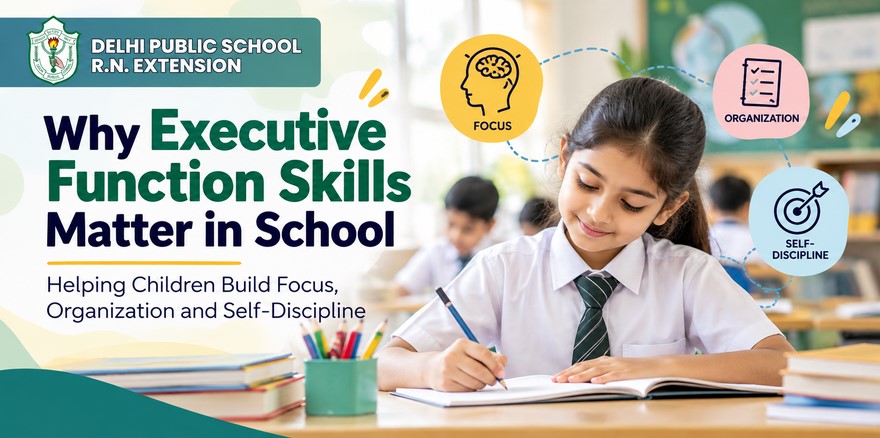
Why Executive Function Skills Matter in School: Helping Children Build Focus, Organization and Self-Discipline
A child may understand a lesson perfectly but still struggle to finish homework, remember instructions or organise school materials. These everyday challenges are not always related to intelligence or academic ability. Often, they involve a set of mental abilities known as executive function skills.
Developing these skills during school years helps children become attentive, responsible and independent learners. For parents looking for the best CBSE school in Ghaziabad, understanding how schools support these abilities is an important part of evaluating a child's overall education.
What Are Executive Function Skills in Children?
Executive function skills are mental processes that help children plan activities, manage attention, remember information, control impulses and complete tasks.
These abilities develop gradually throughout childhood and adolescence. They influence how students approach classroom learning, homework, examinations and everyday responsibilities.
Three important areas include:
Working Memory: Remembering instructions and using information while completing tasks.
Flexible Thinking: Adjusting to new situations and finding alternative solutions.
Self-Control: Managing distractions, emotions and impulsive behaviour.
Together, these abilities support effective learning and responsible decision-making.
Why Executive Function Skills Are Important for Students
1. Improving Focus and Concentration
Classrooms require students to listen carefully, follow instructions and participate in activities. Strong attention-management skills help children remain engaged, even when tasks require sustained effort.
2. Developing Organisation and Time Management
Managing notebooks, preparing assignments and following study schedules become easier when students develop planning habits. These skills are particularly useful as academic responsibilities increase in higher classes.
3. Building Self-Discipline and Responsibility
Self-discipline develops when children learn to manage their actions without constant reminders. Completing homework, respecting classroom rules and accepting responsibility for mistakes encourage greater independence.
4. Strengthening Problem-Solving Abilities
Students frequently encounter unfamiliar questions and challenging assignments. Flexible thinking allows them to reconsider their approach, learn from mistakes and explore different solutions.
How Schools Can Develop Executive Function Skills
Schools play an important role in helping children practise these abilities through structured routines and meaningful learning experiences.
Teachers can encourage students to set achievable goals, organise assignments, participate in group activities and reflect on their progress.
Project-based learning, classroom discussions, sports and creative activities provide opportunities to practise planning, teamwork, patience and decision-making.
At DPS R.N. Extension, Ghaziabad, the educational approach combines CBSE academics with practical learning, sports and co-curricular activities. The school encourages creativity, critical thinking and responsible behaviour, supporting students' academic and personal development.
How Parents Can Strengthen Executive Function Skills at Home
Parents can support their children's development through simple, consistent habits.
Establish Daily Routines: Maintain regular timings for studying, playing, meals and sleeping.
Encourage Independent Planning: Allow children to prepare schoolbags and organise homework.
Break Down Difficult Tasks: Divide larger assignments into manageable steps.
Promote Problem-Solving: Encourage children to think through challenges before offering solutions.
Appreciate Effort: Recognise improvements in responsibility, patience and organisation.
Children develop these abilities at different rates. Consistent guidance and realistic expectations are more helpful than unnecessary pressure.
DPS R.N. Extension: Supporting Learning Beyond Academics
A quality school education should prepare children for examinations as well as everyday responsibilities.
As a prominent CBSE school in Ghaziabad, DPS R.N. Extension provides an educational environment that values academic achievement, creativity, discipline and personal growth.
Through classroom learning, practical activities and co-curricular participation, the school aims to develop confident and responsible individuals.
Frequently Asked Questions
1. What are executive function skills in students?
Executive function skills help students manage attention, remember instructions, organise activities, control impulses and complete academic tasks independently.
2. How can students improve focus and concentration?
Regular study routines, reduced distractions, sufficient sleep, short breaks and age-appropriate activities can help students manage attention.
3. At what age do executive function skills develop?
These skills begin developing in early childhood and continue maturing through adolescence and early adulthood.
4. Can schools help children develop self-discipline?
Yes. Clear expectations, consistent routines, classroom responsibilities and constructive feedback can help children practise self-discipline.
Conclusion
Executive function skills influence how children learn, organise responsibilities and respond to challenges. Developing focus, planning abilities and self-discipline helps students become more independent and confident.
At DPS R.N. Extension, one of the leading CBSE schools in Ghaziabad, education aims to develop academic understanding alongside the practical skills and values children need throughout life.