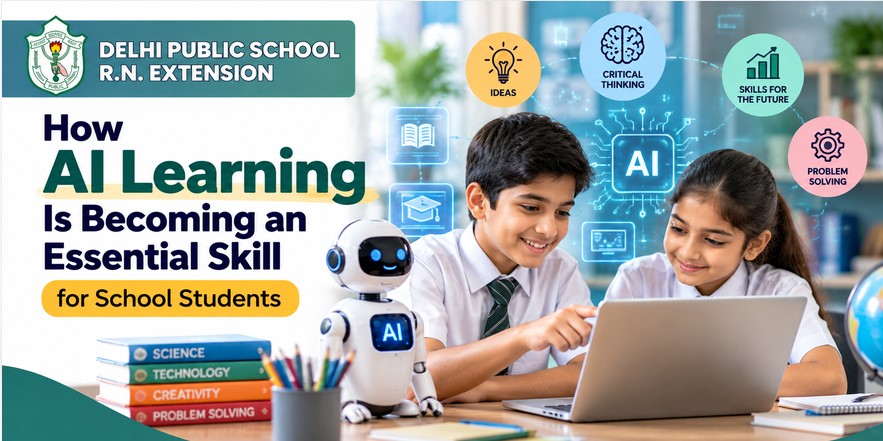
Artificial Intelligence (AI) is no longer limited to scientists, engineers or technology companies. It is gradually becoming part of everyday life, from online searches and language translation to educational applications and digital learning platforms. For today's school students, understanding how AI works is becoming increasingly important.
Children growing up in a technology-driven world need more than basic computer knowledge. They must learn how to use digital tools responsibly, question the information they receive and develop the thinking skills required to work alongside emerging technologies.
At DPS R.N. Extension, one of the leading CBSE schools in Ghaziabad, the importance of preparing students for a changing world goes beyond academic knowledge. Developing curiosity, independent thinking and digital awareness is equally important for their future.
What Is AI Learning for School Students?
AI learning refers to understanding the basic concepts, applications and responsible use of Artificial Intelligence. It does not necessarily mean teaching young children complicated programming languages or advanced computer science.
At the school level, AI education can introduce students to how intelligent systems recognize patterns, analyze information and generate responses.
For example, students may encounter AI through language-learning applications, personalized practice exercises, voice assistants and educational platforms.
Understanding these technologies helps children become informed users rather than simply depending on digital tools for answers.
Why AI Literacy Is Important in Modern Education
1. Developing Critical Thinking Skills
AI tools can produce explanations, summaries and answers within seconds. However, these responses are not always accurate.
Students must learn to verify information, compare reliable sources and question answers that appear incorrect or incomplete.
These habits encourage independent judgement and help children understand that technology should support their thinking, not replace it.
2. Encouraging Creativity and Problem-Solving
AI-based educational tools can help students explore ideas, practice concepts and approach problems from different perspectives.
For instance, students can use age-appropriate AI applications to generate practice questions, understand difficult scientific concepts or explore alternative approaches to mathematical problems.
Teachers can guide children to evaluate these suggestions and develop their own solutions.
3. Preparing Students for Future Career Opportunities
Artificial Intelligence is influencing fields such as healthcare, agriculture, engineering, finance, education and scientific research.
Students do not need to become AI specialists to benefit from understanding the technology.
Basic AI literacy, logical reasoning, communication and adaptability can help prepare children for future academic and professional opportunities.
4. Supporting Personalised Learning
Students learn at different speeds and may require additional support in particular subjects.
Some AI-enabled educational platforms can adjust practice questions, provide immediate feedback and identify areas where students need improvement.
When used appropriately under teacher supervision, these tools can complement classroom instruction and support individual learning needs.
Teaching Students to Use AI Responsibly
Introducing AI into education also requires attention to digital safety, privacy and academic honesty.
Students should understand that sharing personal details with unfamiliar applications can create privacy risks. They must also learn why copying AI-generated answers without understanding them is not a healthy learning practice.
Schools and parents can encourage responsible AI use by teaching children to:
Verify Information: Check AI-generated answers against textbooks and trustworthy educational sources.
Protect Personal Information: Avoid sharing passwords, addresses or sensitive details with AI platforms.
Think Independently: Attempt assignments before seeking digital assistance.
Respect Academic Honesty: Use AI to understand concepts rather than submit generated work as their own.
Recognize AI Limitations: Understand that AI systems can make mistakes or provide misleading information.
These practices help students develop digital responsibility alongside technological knowledge.
The Role of Teachers in AI-Based Education
Technology cannot replace the understanding, encouragement and personal guidance that teachers provide.
Teachers help students interpret information, ask meaningful questions and apply knowledge to real situations.
AI tools are most useful when they complement effective teaching methods rather than replace classroom discussions, practical activities and independent assignments.
A balanced approach ensures that students continue developing communication, teamwork, creativity and emotional understanding.
DPS R.N. Extension: Preparing Students for a Technology-Driven Future
For parents searching for the best CBSE school in Ghaziabad, academic performance is only one consideration. A school's ability to encourage curiosity, critical thinking and adaptability is equally valuable.
DPS R.N. Extension emphasizes academic learning, practical knowledge and the overall development of students.
As digital technologies continue to influence education, developing strong foundations in reasoning, problem-solving and responsible technology use will help children approach new learning opportunities with confidence.
Frequently Asked Questions
1. What is AI literacy for school students?
AI literacy is the ability to understand basic Artificial Intelligence concepts, recognize common AI applications, evaluate AI-generated information and use these technologies responsibly.
2. At what age should children start learning about AI?
Children can begin exploring basic AI concepts through age-appropriate activities during their primary school years. More advanced applications can be introduced gradually according to their understanding and digital maturity.
3. How can AI help students improve their learning?
AI-based educational tools can provide additional explanations, practice exercises, feedback and personalized learning support when used appropriately.
4. Will Artificial Intelligence replace teachers in schools?
AI can assist with certain educational tasks, but teachers remain essential for guidance, emotional support, classroom interaction and understanding individual student needs.
5. Why is responsible AI use important for children?
Responsible AI use helps children protect their privacy, recognise inaccurate information, maintain academic honesty and develop independent thinking skills.
Conclusion
Artificial Intelligence is changing how information is accessed, understood and applied. For school students, learning about AI is becoming an important part of developing digital awareness and preparing for future opportunities.
However, meaningful AI education is not simply about using advanced applications. It involves strengthening curiosity, critical thinking, creativity and responsible decision-making.
At DPS R.N. Extension, Ghaziabad, the focus on academic excellence and all-round student development provides an important foundation for helping children become confident learners in an increasingly digital world.