
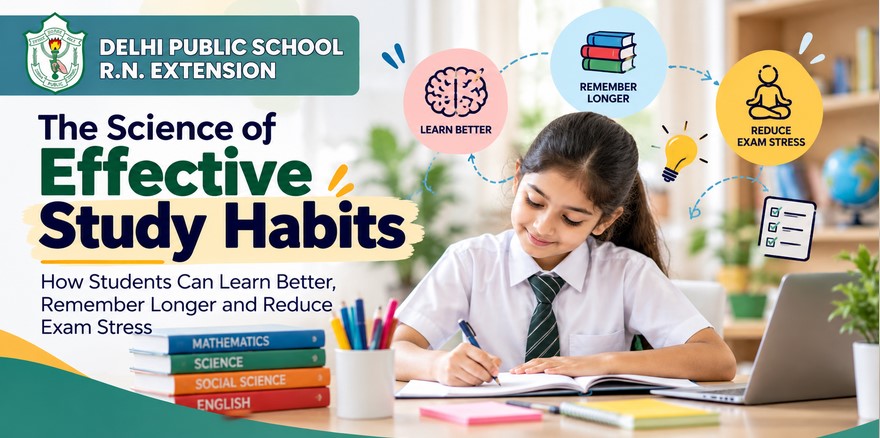
Every student spends time studying, but not every student gets the same results. Some children remember lessons after reading them once or twice, while others struggle to recall information despite spending hours with their books. The difference often lies in how they study rather than how long they study.
Research in educational psychology shows that effective study habits can improve memory, understanding and academic performance. For students following the CBSE curriculum, developing the right learning techniques from an early age can also make examinations less stressful.
At DPS R.N. Extension, one of the leading CBSE schools in Ghaziabad, encouraging meaningful learning and good study habits is an important part of helping children grow into confident, independent learners.
Why Effective Study Habits Matter for Students
Studying effectively involves more than reading textbooks, highlighting important sentences or memorizing answers. The brain learns better when students actively engage with information, revisit concepts at suitable intervals and connect new knowledge with what they already understand.
Good study habits help students:
Understand concepts instead of simply memorizing answers.
Retain information for longer periods.
Improve concentration and time management.
Develop confidence before examinations.
Reduce last-minute revision pressure.
Students who follow consistent study routines are also better prepared to manage increasing academic responsibilities.
1. Active Recall: Learning by Testing Your Memory
Active recall is one of the most useful techniques for improving long-term memory. Instead of repeatedly reading a chapter, students try to remember the information without looking at their textbooks.
For example, after studying a science chapter, a student can close the book and explain the main concepts in their own words.
Other practical methods include answering practice questions, preparing flashcards and writing short summaries from memory.
This process strengthens the ability to retrieve information, making it easier to remember important concepts during examinations.
2. Spaced Repetition: Why Regular Revision Works Better
Many students begin serious revision only a few days before examinations. Although last-minute studying may help with immediate recall, information learned this way can be forgotten quickly.
Spaced repetition involves reviewing lessons at increasing intervals rather than studying everything in one sitting.
For example, students can revise a topic the following day, revisit it after three days and review it again the next week.
This approach gives the brain repeated opportunities to strengthen memory and identify areas that need additional attention.
3. Understanding Concepts Instead of Rote Learning
Memorizing answers without understanding their meaning can make unfamiliar examination questions difficult.
Concept-based learning encourages students to ask questions, explore examples and connect classroom lessons with everyday experiences.
In mathematics, understanding why a formula works is often more useful than remembering the formula alone. Similarly, relating scientific principles to practical situations can make complicated topics easier to understand.
As a recognized CBSE school in Ghaziabad, DPS R.N. Extension encourages an educational approach that values conceptual understanding, curiosity and active classroom participation.
4. Managing Study Time Without Mental Exhaustion
Studying continuously for several hours does not necessarily improve learning. Long sessions without breaks can lead to tiredness and reduced concentration.
Students can divide their study time into manageable sessions with short breaks between them.
A practical routine might involve 25–30 minutes of focused study followed by a five-minute break. However, the ideal duration depends on the student's age, attention span and learning needs.
Setting small, achievable targets also makes larger assignments feel less overwhelming.
5. The Importance of Sleep, Exercise and Healthy Routines
Effective learning continues beyond the classroom and study table.
Sleep plays an important role in memory consolidation, the process through which the brain strengthens newly learned information.
Regular physical activity, balanced meals and adequate rest also support concentration and general well-being.
Students should avoid sacrificing sleep to complete last-minute revision. A consistent routine that includes studying, recreation and rest is generally more sustainable.
How Good Study Habits Can Reduce Exam Stress
Examination stress often increases when students feel unprepared or struggle to manage their workload.
A realistic study timetable can help children organize subjects, monitor progress and avoid unnecessary pressure before examinations.
Parents and teachers can support students by encouraging regular revision, providing constructive feedback and recognizing effort rather than focusing only on marks.
Practicing previous examination questions under timed conditions can also help students become familiar with question formats and manage their time more confidently.
How DPS R.N. Extension Supports Effective Learning
Choosing the best CBSE school in Ghaziabad involves looking beyond examination results to understand how a school develops students' learning abilities.
DPS R.N. Extension focuses on academic development alongside practical learning, creativity, discipline and co-curricular participation.
By encouraging classroom engagement, independent thinking and consistent academic effort, the school aims to help students develop learning habits that remain valuable throughout their education.
Frequently Asked Questions
1. What are the most effective study habits for school students?
Active recall, spaced repetition, concept-based learning, regular revision and consistent study schedules are among the most useful techniques for improving learning and retention.
2. How can students remember what they study for longer?
Students can improve long-term retention by revising lessons at spaced intervals, testing themselves without notes and explaining concepts in their own words.
3. How many hours should CBSE students study daily?
There is no fixed number suitable for every student. Study time should depend on age, class level, academic requirements and individual learning needs. Quality and consistency matter more than simply studying for long hours.
4. How can students reduce examination stress?
Starting revision early, following a realistic timetable, taking regular breaks, getting sufficient sleep and practicing examination questions can help reduce stress.
5. Why is conceptual learning important in CBSE education?
Conceptual learning helps students understand underlying principles, apply knowledge to unfamiliar questions and develop analytical and problem-solving abilities.
Conclusion
Successful learning is not determined by the number of hours students spend with their textbooks. It depends on how effectively they understand, practice and remember information.
By developing healthy study routines, practicing active recall and revising regularly, children can strengthen their academic abilities while approaching examinations with greater confidence.
At DPS R.N. Extension, Ghaziabad, the emphasis on meaningful education and overall student development reflects the importance of preparing children not only for examinations but also for lifelong learning.