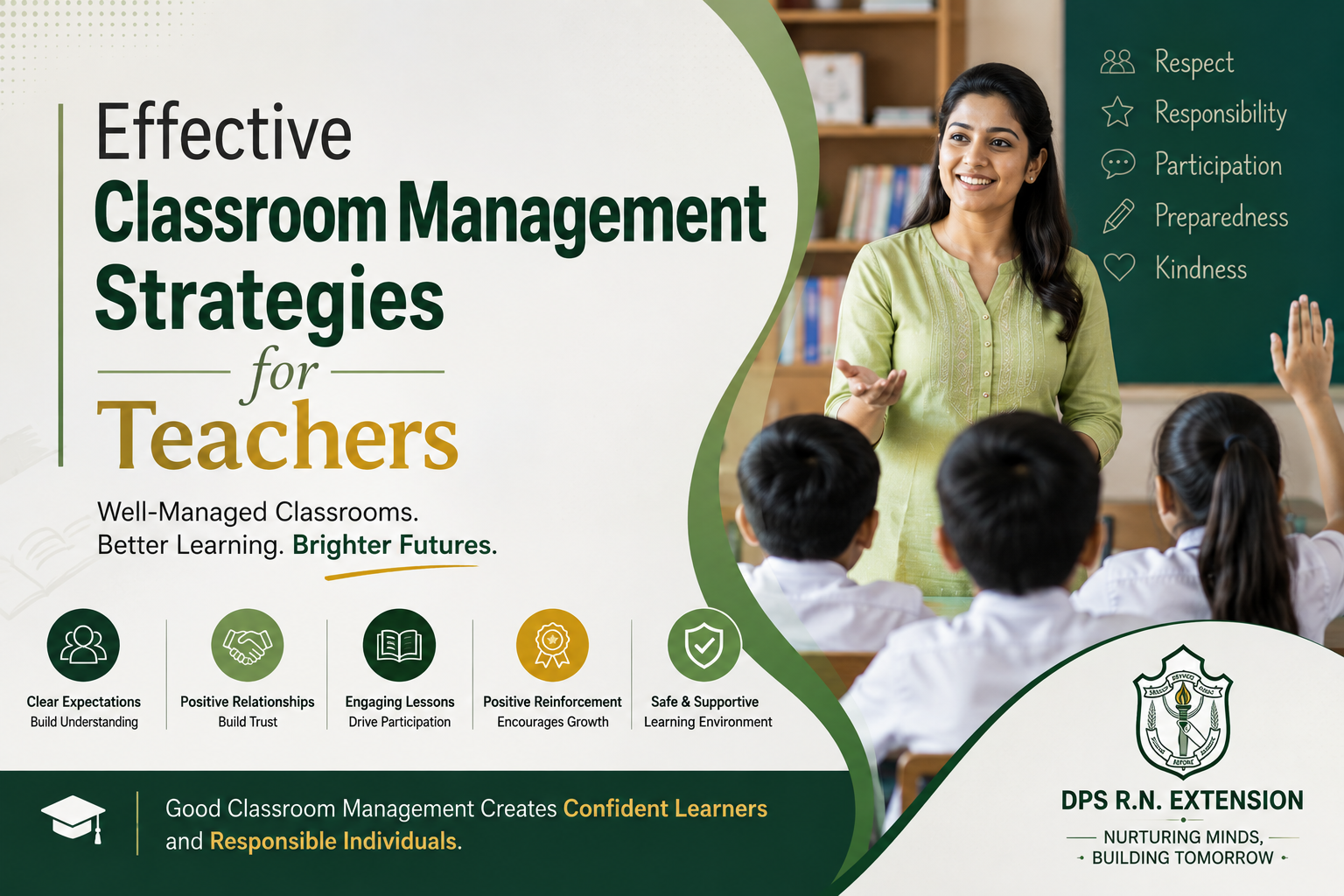
A successful classroom is not necessarily the quietest classroom. It is one where students understand expectations, feel comfortable participating, respect one another and remain actively involved in learning.
For teachers, achieving this balance requires much more than maintaining discipline. Good classroom management creates the conditions in which meaningful teaching and learning can take place. The right Classroom Management Strategies help teachers minimise unnecessary disruptions while encouraging responsibility, confidence and positive behaviour among students.
At DPS R.N. Extension, classroom management can be viewed as an important part of creating a learning environment where academic progress goes hand in hand with students’ social, emotional and personal development.
1. Establish Clear Expectations from the Beginning
Students respond better when they know exactly what is expected of them.
Instead of having a long list of complicated classroom rules, teachers can establish a few clear expectations regarding punctuality, participation, communication, assignments, classroom materials and respect for others.
More importantly, these expectations should be applied consistently.
Consistency helps students understand boundaries and reduces uncertainty. When classroom expectations become part of the daily routine, teachers spend less time repeatedly correcting behaviour and more time focusing on learning.
2. Build Positive Teacher-Student Relationships
One of the most valuable aspects of Classroom Management for Teachers is developing meaningful relationships with students.
Students are more likely to participate and cooperate when they feel that their teacher listens to them, treats them fairly and genuinely wants them to succeed.
Simple practices can make a considerable difference. Learning students' names quickly, acknowledging their efforts, listening when they have concerns and encouraging them after mistakes can gradually build trust.
This does not mean lowering expectations. A teacher can be approachable while maintaining clear boundaries. In fact, students often respond best when warmth and discipline work together.
3. Keep Students Actively Engaged
Many classroom disruptions begin when students lose interest or have too much unstructured time.
This makes lesson planning an important part of classroom management.
Effective Teaching Strategies can include questioning, discussions, collaborative activities, practical examples, problem-solving exercises and appropriate use of technology. Varying the way lessons are delivered can help teachers maintain students' attention and accommodate different learning preferences.
Teachers should also consider the pace of a lesson. If it moves too quickly, some students may become confused. If it moves too slowly, others may lose concentration. Regular interaction allows teachers to understand whether students are following the lesson and adjust accordingly.
4. Encourage Positive Behaviour Instead of Focusing Only on Mistakes
Classroom management should not become a continuous process of identifying what students are doing wrong.
Recognising positive behaviour can often be more effective.
A teacher might acknowledge a student who has shown improvement, appreciate a group that has worked collaboratively or recognise a thoughtful contribution during a discussion.
Positive reinforcement does not always require rewards. Genuine appreciation and constructive feedback can encourage students to repeat desirable behaviours.
Effective Student Behaviour Management therefore focuses on developing self-discipline rather than making students behave simply because they fear consequences.
5. Create Predictable Classroom Routines
Routines provide structure to the school day.
Students should understand what to do when entering the classroom, submitting work, moving between activities, participating in discussions or completing a lesson.
Well-established routines reduce unnecessary confusion and save valuable teaching time.
They are particularly useful during transitions. A classroom can quickly become distracted when students are uncertain about what comes next. Clear instructions and familiar procedures help maintain momentum throughout the lesson.
6. Address Behaviour Calmly and Fairly
Even in a well-managed classroom, disagreements and behavioural challenges will occasionally arise.
How a teacher responds can influence the entire class.
Correcting every small issue publicly may embarrass a student and turn a minor problem into a confrontation. Whenever appropriate, teachers can address individual concerns privately and calmly.
It is equally important to understand why a behaviour is occurring. A student who appears disengaged, for example, may be struggling to understand the lesson rather than deliberately refusing to participate.
Teachers should distinguish between occasional mistakes and recurring behavioural patterns. Consequences, when necessary, should be reasonable, consistent and focused on helping the student make better choices.
7. Give Students Responsibility
Students can become more invested in their classroom when they feel they have a role in it.
Teachers can provide age-appropriate responsibilities, invite students to contribute ideas for activities or encourage them to set personal learning goals.
Group projects can also develop leadership, communication and accountability when roles are assigned thoughtfully.
Giving students responsibility gradually shifts classroom management from something controlled entirely by the teacher towards a shared culture of respect and accountability.
8. Build a Positive Classroom Environment
A Positive Classroom Environment is one in which students feel safe asking questions, sharing ideas and learning from mistakes.
Teachers can encourage this by ensuring that different viewpoints are treated respectfully and that mistakes are seen as a normal part of learning.
Students should never feel that asking for clarification makes them less capable than their classmates.
An inclusive classroom also recognises that children learn differently. Providing different opportunities to participate can help quieter students, confident speakers and students who need additional time all become active members of the class.
9. Communicate with Parents When Necessary
Classroom management becomes stronger when teachers and parents work together.
Communication should not begin only when something goes wrong. Sharing progress, improvement and achievements can help create a healthier partnership between school and home.
When behavioural or academic concerns do arise, constructive communication helps everyone understand the situation and work towards practical solutions.
The goal should be collaboration rather than blame.
10. Reflect and Adapt
There is no single classroom management technique that works equally well for every class.
Different age groups, subjects and individual students may require different approaches. Teachers therefore benefit from regularly reflecting on their methods.
Which activities generated the most participation? When did students become distracted? Are particular instructions creating confusion? Is a student repeatedly struggling with the same situation?
Such observations help teachers refine their approach and develop strategies suited to the actual needs of their students.
Effective classroom management is therefore an evolving professional skill rather than a fixed set of rules.
Conclusion
The strongest Classroom Management Strategies combine structure with understanding. Clear expectations, engaging lessons, consistent routines and appropriate behaviour management provide essential structure, while empathy, encouragement and positive relationships make the classroom a place where students genuinely want to learn.
For schools such as DPS R.N. Extension, effective classroom management supports a much broader educational purpose. It helps teachers create classrooms where students can become confident learners, responsible individuals, thoughtful collaborators and respectful members of their community.
Ultimately, successful classroom management is not about controlling students. It is about creating the right conditions for every child to participate, progress and realise their potential.
Frequently Asked Questions
1. What are classroom management strategies?
Classroom management strategies are techniques teachers use to organize lessons, establish expectations, encourage positive behaviour and create an environment that supports effective learning.
2. Why is classroom management important for teachers?
Effective classroom management reduces unnecessary disruptions, improves student engagement and allows teachers to devote more classroom time to meaningful teaching and interaction.
3. How can teachers manage difficult student behaviour?
Teachers can use clear expectations, calm communication, consistent consequences, positive reinforcement and individual conversations to understand and address behavioural concerns constructively.
4. How can teachers create a positive classroom environment?
Teachers can encourage respectful communication, recognise student effort, promote participation, maintain fair expectations and create an atmosphere where students feel comfortable asking questions and making mistakes.
5. What is the connection between teaching and classroom management?
Effective teaching and classroom management are closely connected. Well-planned, engaging lessons help maintain students' attention, while good classroom management provides the structure students need to participate and learn successfully.